Two separate parts
Right 81.8 g, left 68.4 g by the model. Both are straight prisms from an open mold, and each stands on the table by itself.
A concept for a couple, a wedding or an anniversary. Nothing has physically been cast or lit yet: everything below is calculation.
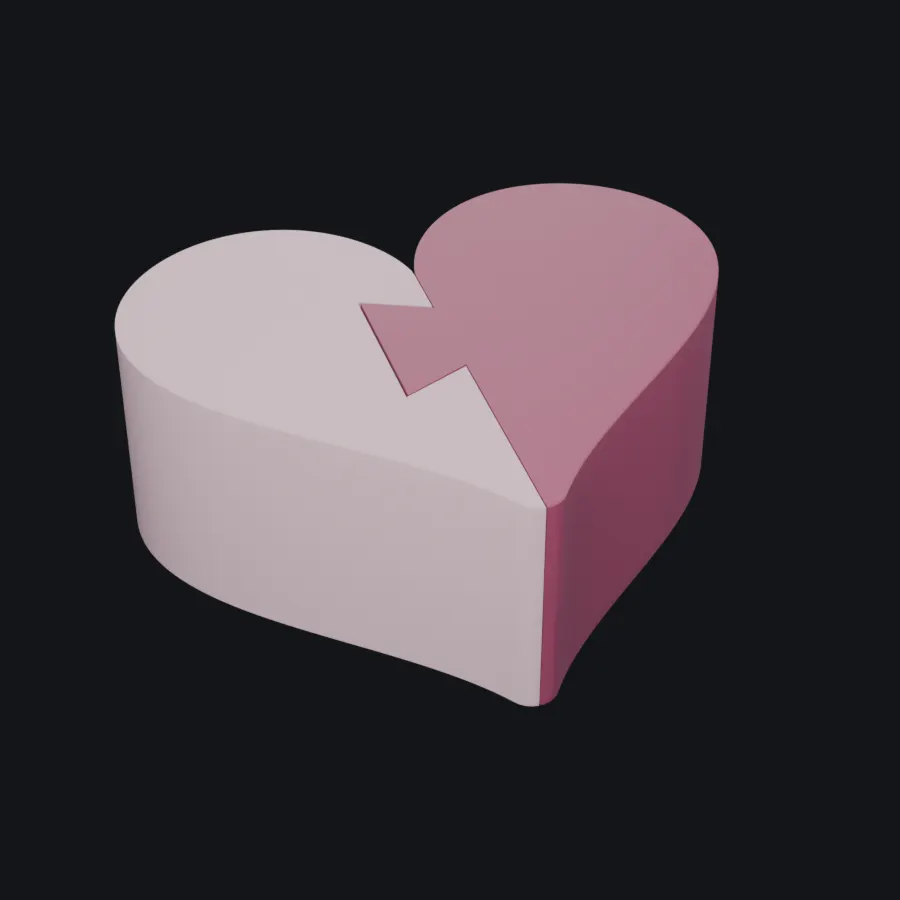
Two halves of a wax heart seat into each other with a dovetail. Light both, and the melt may weld the seam, and then the halves stay together for good. Here those words are only a condition: for now it is a hypothesis, and only a test burn can check it.
Light it in the model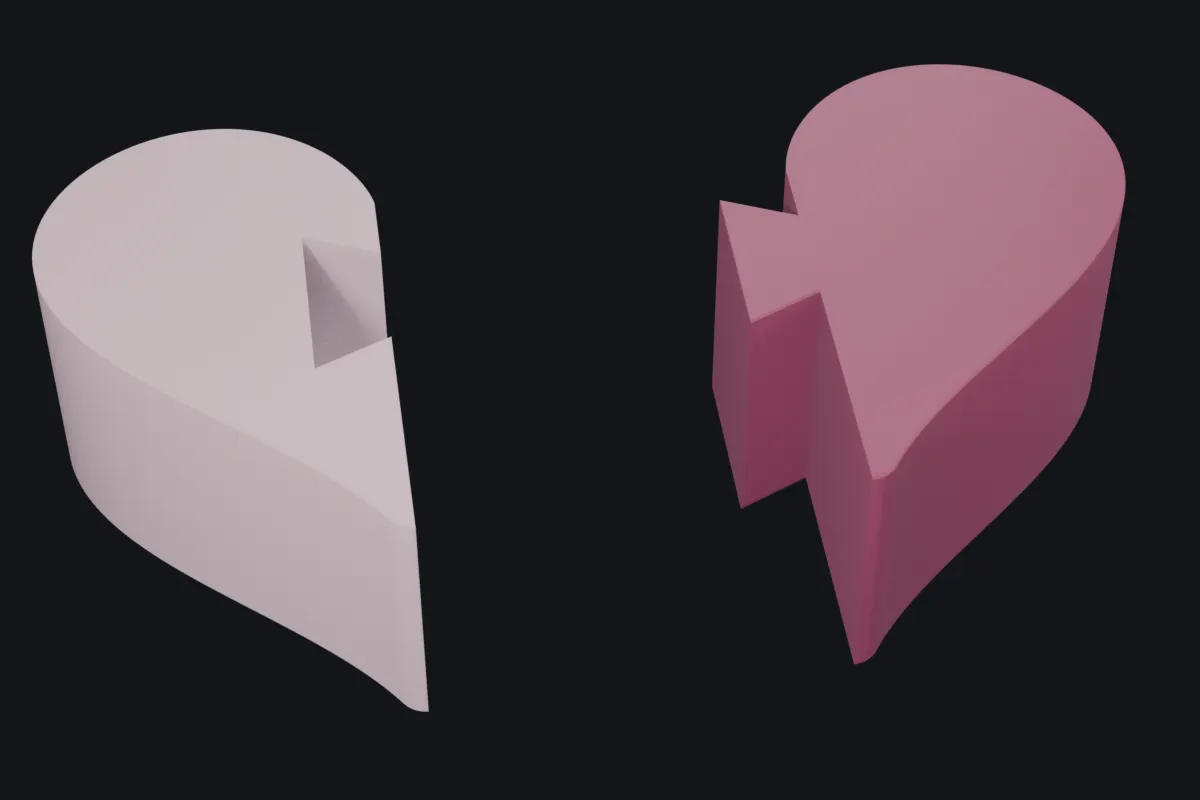
Right 81.8 g, left 68.4 g by the model. Both are straight prisms from an open mold, and each stands on the table by itself.
Neck 14 mm, head 24 mm, length 10 mm. The slot is 0.4 mm larger per side, so the half lowers into it vertically.
The lock does not hold upward: lift by both parts. Modeled play is 0.77 mm across the tail, and 1.17 mm after 20 cycles. That is an estimate, not a measurement.
This is a model, not a measurement. The parameters are assumed, and pool growth comes from a candle makers' rule for a different wax: about Ø25 mm per hour.
Dashed: candle makers' rule. Pool edge: Stefan model. Thin lines: 35 and 45 °C.
Light the left half, the right half or both.
Each lighting restarts the calculation from zero.
Past one hour: the label no longer allows this, so from here it is only calculation.
The model is still computing this time on your device.
Once melt reaches the gap, capillary action takes over: the pressure is small, but so is the path. The lock's gap is 0.4 mm per side. Pick a gap and a length, then release the wax: the animation runs in real time.
Gap
Path along the seam
0.00 s
Viscosity and surface tension here are only an order of magnitude. Only freezing will stop the wax, and the calculation cannot say how far it gets first. The line on the diagram is thicker than the real gap.
If the seam ends up in the melt, the halves should weld and no longer separate. Only if experiment 2 confirms that will we say for good. Without a test burn it cannot be promised.
There is an awkward point. The label limits burning to one hour. By the candle makers' rule the pool reaches the slot at about 1.3 h, in the model not within 2 h. So within an hour it probably will not touch the slot. Whether the halves weld under the label's conditions is still unknown.
Two discs from any pillar candle, cut with a hot wire, no tooling. A seam 10 and 20 mm from the top, three burns of one hour each on a non-combustible stand.
Decorative item for adults, not a toy. Contains small fragile parts. Keep out of reach of children and animals. Before lighting, place on a non-combustible surface, light only the top part, do not leave unattended, burn for no more than 1 hour. Carry disassembled, do not lift by the top part.
Translated from the Ukrainian draft for the whole line of multi-part candles. It is here because the one-hour limit bears directly on the welding hypothesis.
The wording alone does not settle how the item is classified. Before any sale, a short consultation with a lawyer or a laboratory is needed.
If the scene did not start, everything is here. The rule's diameter is computed directly, the model's from melted area. After 2 hours the model's mean radius is 15.4 mm, less than the 16.4 mm to the slot: with these assumed parameters the model does not touch the joint, though the rule puts contact at 1.3 h. Only burning can settle the difference.
| Time | Rule, Ø mm | Model, left, Ø mm | Rule, to slot, mm |
|---|---|---|---|
| 0:00 | 0.0 | 0.0 | 16.4 |
| 0:15 | 6.3 | 12.2 | 13.3 |
| 0:30 | 12.5 | 18.4 | 10.1 |
| 0:45 | 18.8 | 22.3 | 7.0 |
| 1:00 | 25.0 | 25.0 | 3.9 |
| 1:15 | 31.3 | 27.1 | 0.8 |
| 1:30 | 37.5 | 28.6 | reached |
| 1:45 | 43.8 | 29.9 | reached |
| 2:00 | 50.0 | 30.8 | reached |